
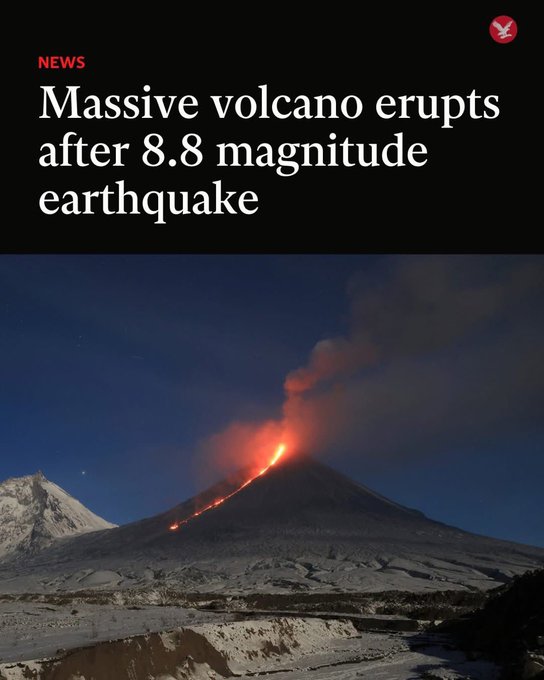
The largest volcano in Eurasia, Klyuchevskaya Sopka, erupted unexpectedly following a powerful 8.8 magnitude earthquake that struck the Kamchatka Peninsula in Russia. The seismic event, which occurred earlier this week, was felt across the region and caused immediate concern among scientists and local residents alike. Geologists report that the volcanic eruption was triggered by the seismic activity, which destabilized the volcano’s magma chamber.
Klyuchevskaya Sopka, a prominent stratovolcano towering over 4,750 meters, is known for its frequent activity but this recent eruption marks a significant escalation. Authorities have issued a safety warning to nearby communities, urging residents to stay clear of the volcano’s immediate vicinity due to the potential for ash clouds, pyroclastic flows, and further eruptions. Satellite imagery shows ash plumes rising several kilometers into the atmosphere, affecting air traffic in the region.
Emergency response teams have been dispatched to monitor the volcano closely, working in coordination with volcanologists from Russian geoscience institutes. The eruption has also raised concerns about the possibility of additional seismic activity in the area, which could lead to further volcanic events. Experts continue to study the eruption’s impact, emphasizing the importance of ongoing vigilance in this geologically active zone.
The Kamchatka Peninsula’s volcanic activity remains a natural hazard for the region, home to numerous active volcanoes. Authorities are urging residents and travelers to heed safety advisories and stay informed through official channels. While the eruption poses immediate risks, scientists emphasize that such events are expected in this tectonically active area, underscoring the need for preparedness and continuous monitoring.