
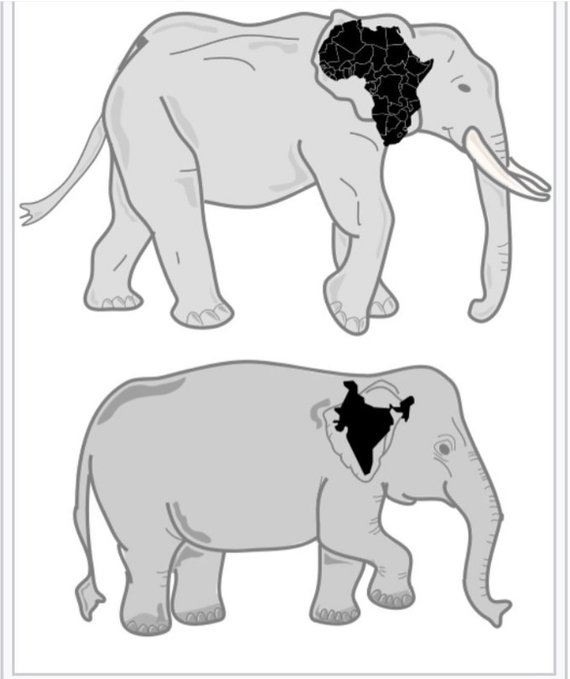
Scientists and wildlife enthusiasts often rely on physical characteristics to differentiate between African and Asian elephants, and a notable feature is their ears. A new observation highlights that the ears of these majestic creatures resemble the shapes of their respective continents—Africa and Asia—making it easier to identify them in the wild.
African elephants have large, broad ears that resemble the continent of Africa itself, with a rounded shape and a sort of “map-like” outline. In contrast, Asian elephants possess smaller, more rounded ears that resemble the Indian subcontinent or parts of southern Asia. This morphological difference is not only a practical identification tool but also a reflection of their evolutionary adaptations to their respective environments.
Experts emphasize that while ear shape is a helpful visual cue, it should be complemented with other distinguishing features, such as the shape of their heads, back contours, and tusk size. African elephants typically have more concave backs and larger tusks, especially in males, whereas Asian elephants often feature smaller tusks or tuskless individuals and a more convex back.
Understanding these differences is crucial for conservation efforts and wildlife monitoring, particularly as habitats shrink and populations face threats. Recognizing elephants by their ear shapes provides an accessible method for park rangers, researchers, and tourists to contribute to the protection of these iconic species.