
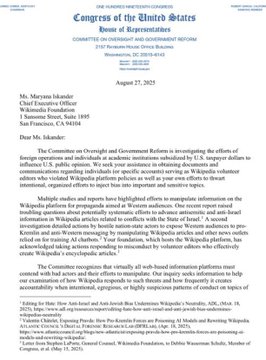
The U.S. House Oversight Committee has announced the launch of an investigation into Wikipedia, focusing on concerns related to potential manipulation of public opinion. The inquiry aims to examine whether the online encyclopedia has been used to influence perceptions on various issues, including political, social, and international topics.
Part of the investigation also centers on allegations of bias within Wikipedia’s content. Specifically, the committee has raised concerns about anti-Israel and antisemitic bias in certain articles and editing practices. These claims suggest that some entries may be skewed or manipulated to favor specific perspectives, prompting scrutiny from lawmakers.
Wikipedia, one of the world’s most widely used information sources, operates through a crowdsourced model involving numerous volunteer editors. The committee’s investigation will likely explore how editorial oversight and content moderation are handled, and whether external influence or coordinated efforts have affected the neutrality of entries on sensitive topics.
This development comes amid growing debates over the role of online platforms in shaping public discourse and the accuracy of information presented to global audiences. The outcome of the investigation could have implications for how collaborative online resources manage content and address potential biases.