
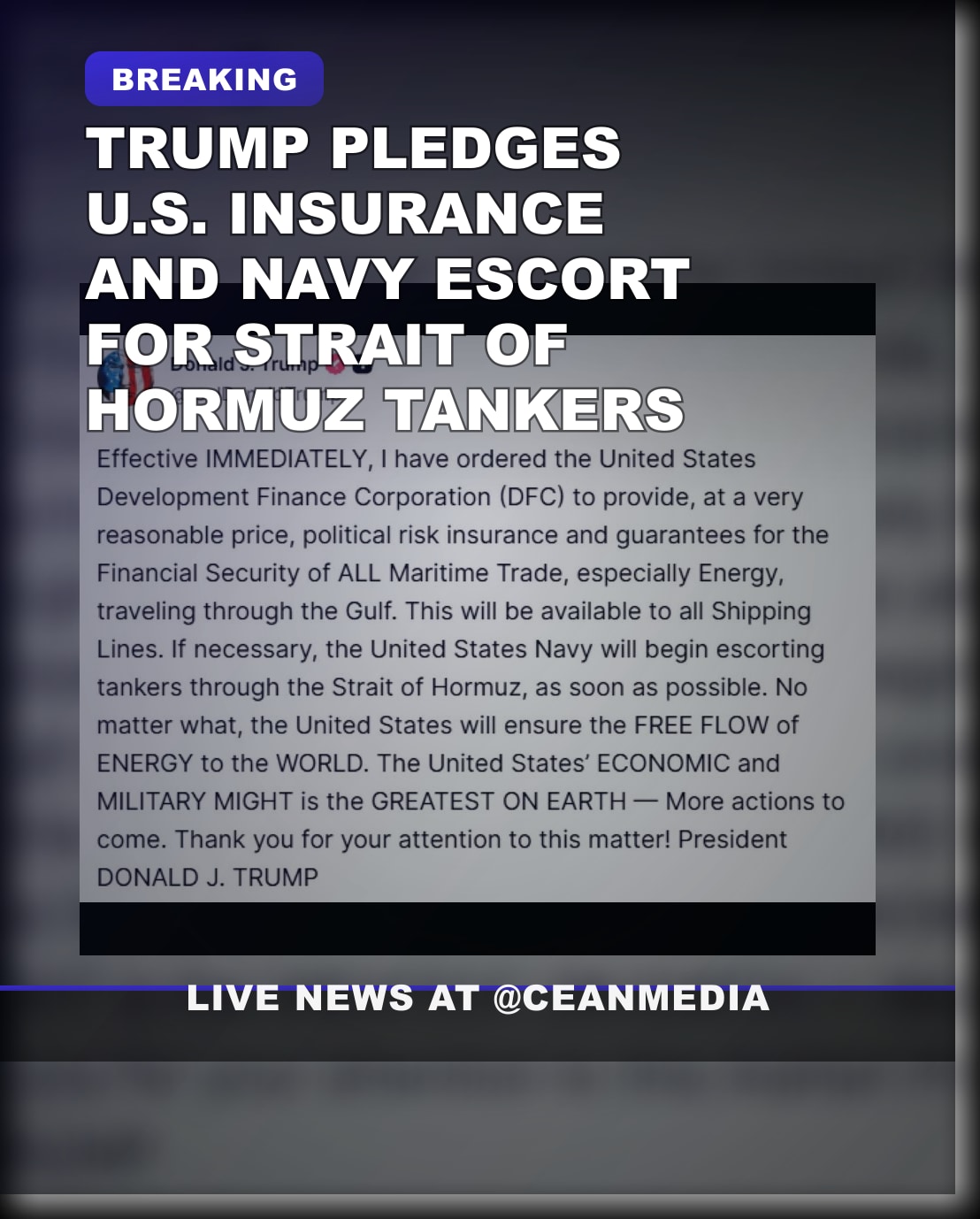
Trump offers shipping insurance and escort plans for Strait of Hormuz routes
In a development that could influence the regional balance of security and commercial flows, a statement attributed to former President Donald Trump indicates that the United States is prepared to provide insurance coverage for vessels navigating the Strait of Hormuz. The offer would be paired with a willingness to authorize U.S. Navy escorts for oil tankers traveling through the strait, should such measures be requested or deemed necessary by commercial operators and allied governments.

The Strait of Hormuz remains one of the most strategically sensitive maritime chokepoints in the world. A narrow passage linking the Persian Gulf with the Gulf of Oman and the Arabian Sea, it handles a substantial portion of the world’s sea-borne crude oil and petroleum products. Even the hint of expanded U.S. protection for ships traversing these waters could have wide-ranging implications for global energy markets, regional security calculations, and the posture of nearby states with competing interests in maritime security and freedom of navigation.
Analysts note that any discussion of shipping insurance and escort plans intersects with several ongoing regional dynamics. On the one hand, international shipping interests stress the importance of predictable, insured, and safe passage through critical corridors that connect crude-producing areas with energy-consuming markets. On the other hand, regional powers and non-state actors monitor such discussions closely, assessing how any external security guarantees might shift risk assessments, alter the calculus of maritime maneuvers, and potentially affect the incentives for different actors to engage in aggressive postures or restraint.
Observers also highlight that insurance arrangements for high-risk sea lanes typically involve cooperation among insurers, ship operators, flag states, and international bodies accustomed to assessing political and security risks. If a government or coalition signals readiness to extend insurance coverage or to provide escort services, it can influence ship routing decisions, deterring or delaying calls at alternative ports and shaping insurance premiums. These effects are particularly consequential for carriers transporting crude, refined products, and other commodities that must move through the Gulf region to reach global markets.
In the broader regional context, the promise of shipping insurance and escort options touches on tensions that have developed across several countries around the Persian Gulf and the wider Middle East. For years, various actors have challenged freedom of navigation norms in the area, sometimes citing security concerns related to interruptions, attacks on vessels, or the targeting of economic assets. While the current discussion centers on insurance and escort capabilities, it sits within a continuum of debates about how external security guarantees should interact with regional security architectures and with the sovereignty of states in the neighborhood.
From a policy perspective, supporters of enhanced protection for maritime routes argue that clear commitments to insure and escort can reduce the exposure of commercial operators to risk. They suggest that such measures could stabilize shipping schedules, lower the cost of capital for vessel operators, and maintain the flow of energy supplies that underpin global markets. Critics, however, caution that such arrangements may escalate tensions if perceived as coercive or as proxies for broader strategic objectives, or could invite provocative responses from rival factions and states along the littoral regions.
Proponents emphasize that any plan would need to be carefully designed to avoid unintended consequences, ensuring that civilian maritime activity remains unimpeded, that rules of engagement are strictly defined, and that all actions remain consistent with international law and the rights of flag states. They advocate for transparent governance, clear criteria for when and how escorts would be deployed, and robust channels for risk assessment and accountability. In addition, there is a call to involve allied partners and international organizations to maintain legitimacy and broad-based support for such measures, should they be pursued.
For now, stakeholders on both sides of the Atlantic are considering the potential operational, legal, and economic dimensions of shipping insurance and escort plans for straits that connect critical oil routes with global markets. The topic underscores how the security of maritime commerce remains tightly interwoven with geopolitical calculations, defense postures, and the steady, continuing debate over how best to balance navigation rights, economic interests, and regional stability in a region marked by long-standing disputes and periodic upheaval.
In practical terms, ship owners and insurers would be attentive to a range of factors if such plans advance toward implementation. These would include the scope of coverage, exclusions, the duration of commitments, the geographic reach of escort operations, the rules of engagement for escorting forces, and the coordination mechanisms with navies, coast guards, and port authorities. Operational logistics, funding arrangements, and the potential implications for insurance premiums would also be central to any decision-making framework adopted by industry participants and state actors alike.
On the diplomatic front, any move toward formalizing shipping insurance and escort services would likely involve consultations with Gulf states, allied navies, commercial carriers, and international maritime organizations. It would be essential to establish a shared understanding of objectives, risk tolerance, and the limits of action in order to prevent misinterpretations or accidental escalations. Transparent communication channels and agreed-upon contingency plans could help mitigate fears of coercive actions or unintended clashes at sea.
Overall, the dialogue around shipping insurance and escort plans for the Strait of Hormuz reflects a broader and ongoing discussion about how to secure critical maritime corridors while respecting sovereignty, international law, and the diverse security concerns present in a volatile but economically vital region. The potential for insured and escorted transit could become a focal point for future policy debates and for assessments of how the international community can collectively support safe and open navigation through some of the world’s most consequential sea lanes.
Related coverage
- Trump Strait of Hormuz insurance escort ships pledge
- Dubai Consulate Drone Strike: Fire Near U.S. Consulate in
- UK drones shootdown: Iranian drones shot by UK forces over
Source Transparency
- This article is based on a short preliminary brief and may not reflect the full details available in ongoing reporting.
- No direct source links accompanied the original brief; the summary is based only on the information available in that brief.
- Information can change quickly; key details may be updated as additional reporting or official statements become available.