
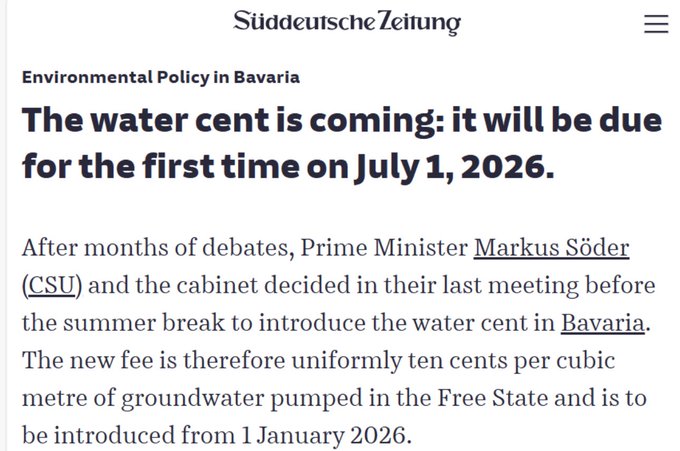
Bavaria, a prominent state in southern Germany, has announced plans to implement a new water tax targeting groundwater extraction. The measure aims to regulate and monitor the overuse of underground water sources, ensuring sustainable management of this vital resource. The tax will apply to all groundwater pumped for commercial, agricultural, and industrial purposes, marking a significant shift in regional water policy.
Prime Minister Markus Söder emphasized the importance of groundwater to Bavaria’s economy and environment, referring to it as “the state’s blue gold.” He highlighted concerns over increasing water scarcity driven by climate change and intensive usage, which threaten both agricultural productivity and ecological balance. The new tax is intended to incentivize more efficient water use and funding for conservation projects.
Environmental groups have generally welcomed the move, seeing it as a necessary step toward sustainable water management. However, some industry stakeholders express concern over the potential financial impact, especially on farmers and businesses heavily reliant on groundwater. The Bavarian government has promised to review the specifics of the tax to balance environmental needs and economic stability.
The legislation is expected to be implemented gradually over the coming months, with detailed regulations and rates still under discussion. Bavaria’s water tax initiative aligns with broader efforts across Germany and Europe to address water scarcity and promote responsible resource use amid changing climate patterns.