
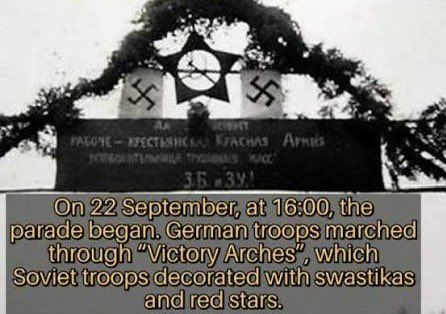
Today marks the 86th anniversary of a significant event at the outset of World War II, when the Soviet Union and Nazi Germany jointly invaded Poland. On September 17, 1939, Soviet forces crossed Poland’s eastern border, following Germany’s invasion from the west earlier that month. This coordinated action significantly contributed to the rapid fall of Poland and marked the beginning of a broader conflict that would engulf the world.
In the aftermath of their invasions, the Soviet Union and Nazi Germany held a joint victory parade in the city of Brest on September 22, 1939. The parade symbolized their cooperation in dividing Poland, as outlined in the Molotov-Ribbentrop Pact, a non-aggression treaty that included secret protocols for partitioning Eastern Europe. The event has since been scrutinized as a moment of alliance between the two totalitarian regimes at the outset of the war.
The joint invasion and subsequent parade are historically regarded as pivotal moments that set the stage for the European theater of World War II. The actions of the Soviet Union and Nazi Germany led to immense upheaval, resulting in the deaths of millions and the reshaping of the continent’s political landscape. Their alliance, though temporary, exemplifies the complex and often ruthless negotiations that preceded the global conflict.
Today, historians and analysts reflect on these events as a stark reminder of the devastating consequences of totalitarianism and unchecked aggression. Commemorations and discussions continue to highlight the importance of understanding these historical actions to prevent similar conflicts in the future.