
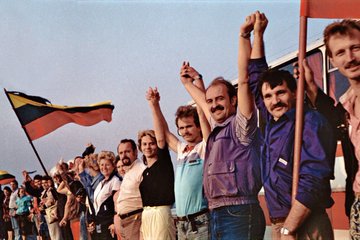
On August 23, 1989, the Baltic countries of Latvia, Estonia, and Lithuania collectively made a historic statement advocating for independence and sovereignty. Approximately two million people participated in forming a human chain spanning around 600 kilometers across the three nations, symbolizing unity and resistance against Soviet control.
The demonstration, often referred to as the Baltic Way or Chain of Freedom, was one of the largest non-violent protests in history, capturing international attention. Participants linked hands across towns, cities, and rural areas, emphasizing their shared desire for independence and demonstrating their resolve to challenge decades of Soviet dominance.
This event was a significant milestone in the broader movement toward independence that culminated in the early 1990s, when the Baltic states reasserted their independence from the Soviet Union. The human chain not only showcased the courage of ordinary citizens but also underscored a powerful message: that freedom cannot be suppressed by force. The Baltic Way remains a symbol of peaceful resistance and national unity in the history of Eastern Europe.